Ocean robots shouldn’t need a ship to recharge.
Cove is a floating depot that turns wave motion into power and lets autonomous underwater vehicles dock, recharge, and go back to work. No crew, no vessel, no downtime.
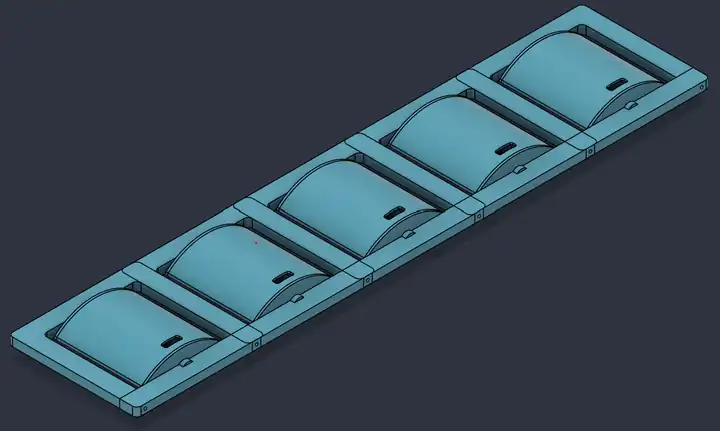
Schematic simulation, not to scale
The ship is the bottleneck.
Autonomous underwater vehicles survey pipelines, map the seafloor, and monitor the ocean. They run on batteries that last a day or two. Then a crewed ship has to find them, haul them out, and recharge them.
- Endurance
- 1 to 2 days
A small survey AUV carries roughly 4 to 5 kWh. When it is gone, the mission ends whether the job is done or not.
- Energy on board
- 4 to 5 kWh
About what a home battery holds. It has to cover propulsion, sensors, and the trip back.
- Dominant cost
- The ship
Vessel time, crew, and fuel dominate the cost of running AUVs. The robot is cheap; tending it is not.
- Charging at sea
- None
There is no infrastructure for robots to recharge unattended. Every operator solves it the same expensive way.
How Cove works
A wide floating frame with rows of hinged panels. Waves rock the panels; the panels turn generators; the generators fill a battery bank; the battery charges docked vehicles.
Cross-section of one bay. Schematic, not to scale.
Waves rock the panels
Each bay holds a curved panel on a pivot. Passing waves swing it back and forth.
Panels drive generators
The pivot turns a gearbox and generator. Many small units, not one big one, so the platform keeps working if one fails.
Power goes to a battery bank
Energy is stored on the platform, so charging does not depend on the sea state at that moment.
AUVs dock and recharge
Vehicles dock in a sheltered bay using an industry-standard inductive connector, offload data, and leave on a full charge.
The wave-energy physics here is well established; what is new is packaging it as a charging depot for robots. Power figures we quote are screening estimates from a physics model run on real Gulf of Mexico wave data, not measurements.
Sized against real sea states.
Our energy model runs on three years of NOAA buoy records from station 42035, twenty-two nautical miles east of Galveston. The Gulf is not the North Sea: typical waves are under a metre. The design has to earn its keep in ordinary conditions, not in storms.
- 0.82 mMean significant wave height
- 1.40 m90th percentile
- 5.45 mLargest recorded
- 33,668Hourly observations
Show as tableHide table
| Month | Mean (m) | 90th pct (m) | Max (m) | Observations |
|---|---|---|---|---|
| Jan 2023 | no data (buoy outage) | |||
| Feb 2023 | no data (buoy outage) | |||
| Mar 2023 | 0.98 | 1.36 | 1.60 | 283 |
| Apr 2023 | 1.01 | 1.47 | 2.47 | 1,434 |
| May 2023 | 0.64 | 1.16 | 1.84 | 1,476 |
| Jun 2023 | 0.76 | 1.23 | 1.68 | 1,438 |
| Jul 2023 | 0.65 | 0.98 | 1.39 | 1,487 |
| Aug 2023 | 0.70 | 1.11 | 2.53 | 1,482 |
| Sep 2023 | 0.55 | 0.90 | 1.33 | 1,422 |
| Oct 2023 | 0.92 | 1.52 | 2.09 | 1,150 |
| Nov 2023 | no data (buoy outage) | |||
| Dec 2023 | no data (buoy outage) | |||
| Jan 2024 | no data (buoy outage) | |||
| Feb 2024 | no data (buoy outage) | |||
| Mar 2024 | no data (buoy outage) | |||
| Apr 2024 | no data (buoy outage) | |||
| May 2024 | 1.02 | 1.37 | 2.27 | 959 |
| Jun 2024 | 1.00 | 1.86 | 3.19 | 1,440 |
| Jul 2024 | 0.76 | 1.05 | 5.45 | 1,460 |
| Aug 2024 | 0.46 | 0.78 | 1.29 | 1,486 |
| Sep 2024 | 0.75 | 1.69 | 2.75 | 1,433 |
| Oct 2024 | 0.87 | 1.44 | 2.40 | 1,487 |
| Nov 2024 | 1.07 | 1.76 | 2.51 | 1,437 |
| Dec 2024 | 0.98 | 1.46 | 1.82 | 1,488 |
| Jan 2025 | 1.09 | 1.71 | 3.37 | 1,468 |
| Feb 2025 | 0.84 | 1.54 | 2.12 | 1,342 |
| Mar 2025 | 0.89 | 1.49 | 2.38 | 1,487 |
| Apr 2025 | 1.03 | 1.78 | 2.26 | 1,428 |
| May 2025 | 1.05 | 1.66 | 2.37 | 1,483 |
| Jun 2025 | 0.87 | 1.14 | 1.83 | 1,437 |
| Jul 2025 | 0.68 | 0.92 | 1.39 | 1,484 |
| Aug 2025 | 0.43 | 0.71 | 1.29 | 1,478 |
| Sep 2025 | 0.62 | 0.91 | 1.61 | 699 |
| Oct 2025 | no data (buoy outage) | |||
| Nov 2025 | no data (buoy outage) | |||
| Dec 2025 | no data (buoy outage) | |||
Early. Here is exactly where.
We would rather you know the stage than guess it. This log is the whole story so far.
- DoneArchitecture chosenFloating ladder frame. Five-bay prototype module modelled in CAD.
- DoneEnergy modelBuilt on three years of NDBC buoy records off Galveston. Outputs are screening estimates, not measurements.
- Oct 2026Good Bull Pitch winnerTexas A&M McFerrin Center for Entrepreneurship.
- NowAdvisorsIn conversation with marine robotics labs at APL-UW and Oregon State.
- NextSingle-bay bench rigThen a five-bay tank test.
- StagePre-revenue, pre-seedStudent-founded at Texas A&M University.
Three undergraduates at Texas A&M.
Built in College Station, Texas
Siddharth Seshampally
Co-founder · Oceanography
Product, physics, and customer conversations.
Aarya Bookseller
Co-founder · Computer science, with physics and statistics minors
Software and controls.
Salvador Magaynes
Co-founder · Mechatronics
Mechanical design and electronics.
Tell us what a cut-short mission costs you.
If you operate AUVs, run a marine robotics lab, or work on offshore infrastructure, we would like to hear how you recharge today and what it costs. A reply from you shapes what we build next.